|
By: Chin Sze Jie
Postgraduate Student, Institute of Plantation Studies (IKP) and Recipient of the Consolation Prize in the "Are You the Next Young Roots?" Writing Competition organized RSPO/IKP
The palm oil industry is often discussed in relation to economic growth, food production and environmental sustainability. As one of the most heavily consumed vegetable oils worldwide, it supports millions of livelihoods and national economies. Yet its growth brings a serious challenge: handling palm oil mill effluent (POME) sludge oil. Rather than treating POME sludge oil purely as something to be disposed of, I believe we can use innovation and technology to reframe it as a useful resource.
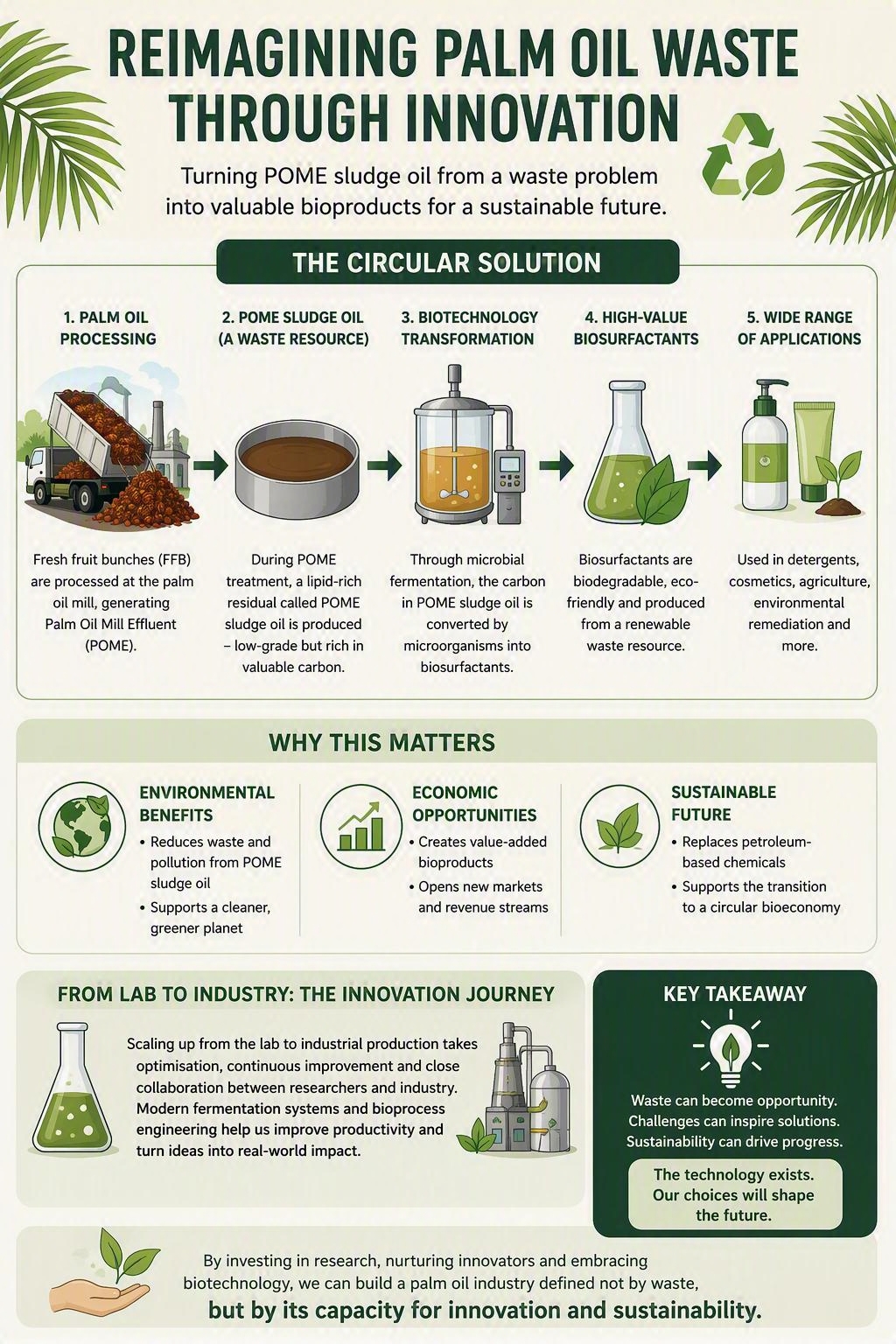
The circular economy model is increasingly being adopted across various sectors. The idea is simple but powerful: waste from one process can become the raw material for another. In the palm oil sector, biotechnology offers an exciting opportunity to put this concept into practice. Through microbial fermentation, POME sludge oil can be converted into high-value bioproducts instead of being treated solely as a disposal problem.
One promising example is the production of biosurfactants, surface-active compounds produced by microorganisms. They can be used in a wide range of applications, including detergents, cosmetics, agriculture and environmental remediation. Unlike many conventional surfactants that are derived from petroleum, biosurfactants are biodegradable, environmentally friendly and produced from renewable resources.
What makes this technology particularly exciting is its ability to transform an abundant waste stream into a sustainable product. During POME processing, a residual fraction known as POME sludge oil is generated, a low-grade and underutilised lipid-rich material. It is recovered from palm oil mill effluent and still contains valuable carbon sources that can support microbial growth. By harnessing the power of biotechnology, researchers can utilise these resources to cultivate microorganisms capable of producing biosurfactants. In essence, a waste product from the palm oil industry becomes the feedstock for another valuable process.
This approach represents more than just scientific innovation. It demonstrates how technology can help address multiple challenges simultaneously. First, it reduces the environmental burden associated with waste management. Second, it creates new economic opportunities through the production of value-added bioproducts. Third, it supports the transition towards greener manufacturing practices by replacing petroleum-based materials with renewable, biodegradable alternatives.
However, innovation does not stop at the laboratory bench. One of the greatest challenges in biotechnology is scaling up a process from small laboratory experiments to industrial production. A technology that works in a flask must be carefully optimised before it can perform reliably in large bioreactors. This process requires continuous improvement, creative problem-solving and close collaboration between researchers and industry stakeholders.
As a young researcher, I have witnessed how technological advancements can unlock new possibilities within the palm oil sector. Modern fermentation systems, process monitoring tools and bioprocess engineering techniques allow us to improve productivity and deepen our understanding of microbial behaviour. These technologies are not only helping scientists develop sustainable solutions but are also preparing the industry for future challenges.
The path towards a more sustainable palm oil industry requires a genuine commitment to innovation. Rather than focusing solely on maximising production, the emphasis must also shift to improving resource efficiency and reducing waste. Biotechnology offers a clear route to achieving both. Converting POME sludge oil into valuable products like biosurfactants builds a more resilient and sustainable industry that benefits both people and the environment.
Through innovation and technology, waste can become opportunity, challenges can inspire solutions, and sustainability can become a driver of progress rather than a limitation. Ultimately, the question is not whether we have the technology to build a more sustainable palm oil industry. The technology already exists. The real challenge is how effectively we choose to implement it. By channelling investment into research, nurturing emerging innovators and embracing biotechnological solutions, we can ensure that the future of palm oil is not defined by waste, but by its capacity for innovation.
|